Trump says Iran regime change ‘probably doable’, but what is his endgame?
US war funding runs through January as Tehran weighs military action to break blockade
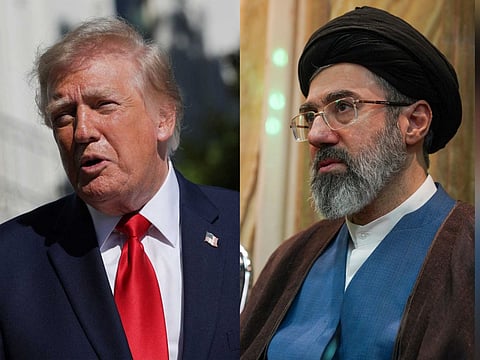
Dubai: US President Donald Trump has described regime change in Iran as “probably doable” but insisted it was not his objective, raising fresh questions about Washington’s endgame in a war that has dragged on for nearly nine months without a resolution.
“I just don’t want them to have a nuclear weapon. I was never for or against regime change, that was never a criteria for me,” Trump told the New York Post in an interview on Tuesday.
Trump also revealed that the war was funded through the end of January, acknowledging that his military options could become more limited once Democrats take control of Congress.
Warning that Democrats could turn what he described as a military victory into a defeat, Trump insisted that Washington could end the conflict whenever it chose.
“I don’t know how they could do that politically, because we have a win. We can put that war to bed anytime we want,” he said.
Yet Iran is weighing military action to break the US naval blockade, Israel is raising the prospect of preemptive strikes and attacks on commercial shipping continue in the Strait of Hormuz.
Trump’s narrowing window
Trump’s funding disclosure adds a new dimension to a conflict already complicated by competing strategic objectives and stalled diplomatic efforts.
“But up until really the end of January, pretty much, you know, we’re funded,” Trump said when asked about the window for a potential new offensive.
While January does not represent a formal deadline for ending the war, congressional restrictions on military spending could complicate Washington’s ability to sustain offensive operations.
Trump’s remarks also raise questions about whether Washington will intensify pressure on Tehran in the coming weeks or seek a diplomatic breakthrough before facing greater constraints at home.
Quick facts: What happens after January?
January 3: Democrats take control of both chambers of Congress, gaining greater influence over military spending.
January 31: Trump’s stated timeframe for existing war funding expires. This does not automatically end military operations.
Funding restrictions: Congress could refuse additional funding or prohibit spending on offensive operations against Iran.
Presidential powers: Trump remains commander-in-chief but could face financial and legal restrictions on continuing the war.
Bipartisan pressure: Some Republican senators are already open to negotiating restrictions on Iran war funding.
Military exceptions: Proposals under discussion would allow the continued defence of US forces and evacuation of civilians.
Diplomatic pressure: Funding constraints could increase pressure on Washington to pursue a negotiated settlement.
US and Israel: Diverging objectives
Trump’s comments on regime change came as Israeli Defence Minister Israel Katz accused Iran of developing chemical weapons and vowed to prevent Tehran from acquiring them.
Katz said Iran had not yet developed the capability to attack Israel with such weapons. The allegation has not been independently verified.
He also raised the possibility of preemptive military action if Israel identified an impending Iranian attack.
However, Avigdor Liberman, a key ally of Eisenkot, said on Wednesday that despite the seriousness of the chemical weapons allegations, there was no intelligence or operational justification for an immediate Israeli attack on Iran.
Last week, CNN, citing US intelligence, reported that Iran was developing plans for a potential dirty bomb attack targeting senior Trump administration officials.
Iranian Foreign Minister Abbas Araghchi dismissed the report as “Iraq War-style propaganda”.
Iran weighs military action
While Trump faces potential political constraints, Tehran is confronting mounting economic pressure from Washington’s naval blockade.
The Institute for the Study of War and the Critical Threats Project said on Tuesday that the economic costs of the blockade were becoming increasingly untenable for Iran.
The researchers also reported that Iran appeared to be developing new ballistic missile variants, although its remaining production capacity and stockpiles remained unclear.
Mahdi Mohammadi, an adviser to Iranian Parliament Speaker Mohammad Bagher Ghalibaf, said Iranian decision-makers agreed that the blockade constituted an “act of war” and that using military force to end it would be legitimate.
However, he acknowledged that preparations remained incomplete.
Iranian officials have also raised the possibility of dispatching oil tankers to breach the blockade.
Hormuz tensions mount
On Wednesday, Iran’s Islamic Revolutionary Guard Corps Navy claimed that two oil tankers caught fire after striking naval mines in the Strait of Hormuz. The claim has not been independently confirmed.
Meanwhile, Iranian First Vice-President Mohammad Reza Aref insisted Tehran was not concerned about the blockade, citing increased cargo clearance through alternative borders and strong reserves of strategic goods.
Tehran continues to demand that Washington meet its conditions before negotiations resume, including lifting the blockade and sanctions and releasing seized Iranian assets.
What is Trump’s endgame?
With Iran threatening military action, Israel raising fresh security concerns and Washington facing potential funding constraints, the prospects for ending the conflict remain uncertain.
Trump may have clarified what he wants from Iran, but how he intends to achieve it remains unclear.
With Tehran refusing to back down, Hormuz still disrupted and Washington facing potential funding constraints after January, the question is whether Trump can secure a diplomatic settlement or whether the region faces another round of military confrontation.


