Jumeirah Mosque: A window on the Muslim world
Jumeirah Mosque offers an insight to Emirati culture
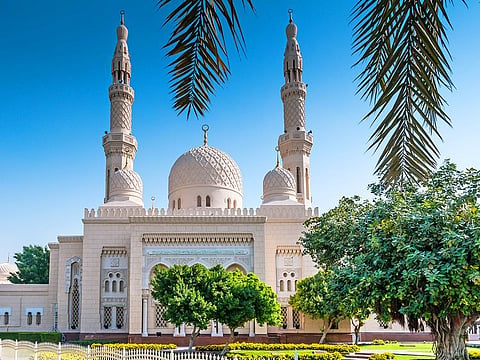
Dubai: Right between high-end boutiques and fast food chains on Beach Road is Jumeirah Mosque, a true demonstration of the contrast between globalised modernity and cultural heritage.
Residents might not give the mosque a second glance as they can easily get caught up in the fast-paced life of the cosmopolitan city with its skyscrapers and booming construction projects. But despite the rapid development of the city, Emirati values and customs continue to thrive as various groups try to pass on these values to expatriates.
One such group is the Shaikh Mohammad Centre for Cultural Understanding (SMCCU), whose aim is to break down barriers between people of various nationalities, and to help them understand the traditions, customs and religion of the UAE.
The centre offers free guided tours of Jumeirah Mosque, the only mosque in the city that is open to non-Muslims. The mosque has grown to become one of Dubai's landmarks as it is located in what is now the most popular neighbourhood of the city.
Construction of the Jumeirah Mosque began in 1975 under instructions of the late Shaikh Rashid Bin Saeed Al Maktoum, and was completed in 1978. It can accommodate 1,200 worshippers.
The tours at the mosque are conducted by Emirati volunteers. Non-Muslims may not enter the mosque unless they are accompanied by a designated tour guide, who starts the tour promptly at 10am every Saturday, Sunday, Tuesday and Thursday. No prior bookings are necessary. Visitors can simply register prior to the tour at the mosque's entrance.
Conservative dress
Conservative dress for men and women is essential when entering the mosque. Women are required to cover their arms and legs, and they have to wear a headscarf, while men are allowed to wear shorts that are long enough to cover the knees.
Although the tours are conducted in English, officials at the cultural centre point out that special arrangements are regularly made for tour operators who want to book private tours and bring their own translators.
"Private tours are also very popular and are conducted two or three times a week. Two slots are available in order to cater the the high demand from visitors from all over the world, such as from Italy, Japan and Korea," says Sharifa Madgwick, general manager at SMCCU.
In 1995 the mosque tour was conducted from a stand on Al Dhiyafah Street with only a handful of volunteers. Now there are over 300 registered volunteers who are willing to lend a helping hand.
"As many as 600 people visit the mosque in a day, although we're now in a slump during the summer. "But it will become very popular again during Ramadan. We will also hold night tours," says Sharifa.
"We are always looking for university students to help us out. They can also benefit from the experience by interacting with the media and giving tours and presentations."
Over the past ten years, Jumeirah Mosque has become renowned as a learning centre and focal point of the Open Doors Open Minds programme at the SMCCU.
The tour lasts approximately an hour and a half, and involves an introduction about ablution, the five pillars of Islam, as well as a prayer demonstration.
"There are 167 top questions, but the most popular one is why men wear white and women black," she notes, explaining that while black is the traditional colour, it is also a colour that is not transparent.
The tour is an emotional, visual and informative experience as tour guides do their utmost to explain their culture and religion, while visitors admire the Fatimid-influenced architecture of the mosque.


