Memories of the best-loved bard
Literati and peers remember poet Sultan Al Owais on his tenth death anniversary
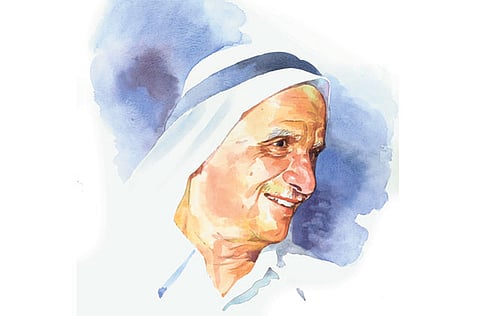
Fond memories flooded back during a seminar held to mark the tenth death anniversary of the poet Sultan Al Owais (1925-2000).
The poetry seminar brought together the literati and the media at Sultan Bin Ali Al Owais Cultural Foundation on January 2.
The Poetry Club of the Emirates Writers Union organised the event, featuring the writer and journalist Wael Al Jishi, poet Mahmoud Noor and author Abdul Ilah Abdul Qader, who is also the executive director of the foundation. The foundation had previously arranged a similar event in Fez, Morocco, a year after the festival first started in Dubai in 2001. That event included an art exhibition, where many artists presented works inspired by Sultan Al Owais's poems.
Sultan Al Owais penned his poetry over a period of 30 years. He is not only considered the best poet to emerge from the UAE but also the best-loved bard in the entire Gulf region.
Born in the village of Al Hirah, Sharjah, in 1925, Sultan Al Owais was raised in a household known for its love of science and literature. His family's predilection for education made him keen on poetry. Even at an early age, he showed the talent that eventually inspired future generations, giving the UAE many prominent men of letters, researchers and scholars such as the poet Salim Bin Ali Al Owais, the historian Omran Al Owais and the writer Ahmad Bin Ali Al Owais.
His poems were popular in Syria, Lebanon, Egypt and other countries. Through his friendships with other Arab poets, Sultan Al Owais introduced his country and its poets throughout the Arab world.
Poet, lyricist and philanthropist
It was quite a feat for a humble man from a family that was engaged in the pearl trade. The Al Owais family has given the business world some famous figures, such as Ali Abdullah Al Owais, Sultan Al Owais's father, who prospered greatly from commercial operations, until the demise of the pearl trade.
The poet himself became one of the most successful businessmen in the UAE. Trade took Sultan Al Owais on frequent travels, especially to India, something that enriched his life.
As a lyricist, he produced printed works considered by critics as a bridge between two generations of poets in the UAE. In addition to literature and business, Sultan Al Owais was also a philanthropist, benefiting people in his country and in the wider Arab world. One of the most prominent awards in the Arab world bears his name.
Mubarak Al Oqaili (1880-1954), Salem Bin Ali Al Owais (1887-1959) and Ahmad Bin Sulayem (1905-1976) were the luminaries of UAE literature during the 20th century, particularly classical Arabic poetry. Three other poets from Sharjah, collectively known as the Al Hirah group, were also successful — Khalfan Mosabah (1923-1946), Shaikh Saqr Al Qasimi (1925-1993), former ruler of Sharjah, and Sultan Bin Ali Al Owais (1925-2000). The Al Hirah group's works seemed to have been heavily influenced by the Apollo and the romantic poets.
As Sultan Al Owais observed in an interview: "I was one of the three young men whose fathers had libraries at home. We spent [our] free time reading books. As close friends, we lived in Al Hirah region. Shaikh Saqr Sultan Al Qasimi and Khalfan Bin Mosabah started writing poetry earlier; I then followed. We also worked [together] in our businesses, which brought us closer. We met at night reciting our poems and showing them to our friends. My two companions were able to preserve their verses while I lost most of my compositions."
Sultan Al Owais was not concerned about collecting his literary works. He was only writing them and giving the copies to journalists for publication (later some scholar collated the work in books). He published his first poem, Al Warda, or The Rose, in the Lebanese magazine Al Worrod — The Roses — in 1970. It was a romantic verse that spoke about "the moistened flower".
Most of Sultan Al Owais's poems were erotic but they lacked the kind of eroticism found in the poems of Omar Bin Abi Rabe'ei or Nizar Qabani. Traditional and contemporary names of Arab women, such as Fatima, Salma, Laila, Yusra and Loulo materialised in his verses. For him, a woman was a symbol of love, life, poetry and existence. His style of writing is classical but he follows the puritanical Arab poets. He embraced a new classicism and his erotic presentation delved into the abstract. In his poems, love is existential rather than realistic.
Sultan Al Owais wrote poems similar to the Japanese haiku — condensed, short and expressive. Influential Arab poets such as Ebrahim Naji, Ali Mahmoud Taha, Mahmoud Hassan Esmail, Badwi Al Jabel, Omar Abu Richa, Bishara Al Khoury and Nizar Qabani had an impact on Sultan Al Owais. He admired the Syrian poet Adonis for his book Choices of Arab Classic Poetry because it was compact, fleeting and animated. His emphasis was on quality and not quantity of expression. For this reason, his verses became the "poetry of vision". The same technique was considered revolutionary in modern Arabic poetry. Sultan Al Owais wrote only occasionally on the situation in the Arab world. The subject of love reigned supreme in his poetry.
Some critics see him as a traditional poet but others consider him a modern one. In reality, he could not be classified as belonging to any group. Obviously, his Arab heritage influenced his poetry. Three elements shone clearly in his poetry: the woman, the sea and his homeland. He linked all these elements in a philosophical context.
In one interview, Sultan Al Owais explained his concept of poetry. "Poetry is like representational art. When you hang a painting on the wall, you ask the public to see its contents and enjoy its beauty. So it is with the poem that is distant from philosophy and ambiguity."
He remained hesitant about using his father's Nabati poetry and also the contemporary writing approach that was open to all readers. He knew that the audience for Nabati poetry was limited and localised but he did not express any antagonism towards the modern Arabic poetry because he believed in the essence of artistic expression. Besides, the literary movement at that time was still developing. Sultan Al Owais merely provided a unique approach.
Sultan Al Owais's poetry was popular in the Gulf region and the Arab world. He was recognised and respected in countries such as Lebanon, Syria and Egypt.
He became an emissary for his country, introducing other home-grown poets to the literary fold. Coming from a family that used poetry as a means to express passion, he continued the trend of his father Shaikh Ali Al Owais, a Nabati poet well known in Al Hirah. His cousin Salim Bin Ali Al Owais emerged as a noteworthy contemporary poet who wrote in the modern style, influenced by poets in Egypt and Syria.
At the seminar, Emirati poet Mahmoud Noor shared memories of his close friendship with Sultan Al Owais by reading some of his poems while mentioning that once, the late poet had dedicated a poem to him titled Talent of Poetry.
Author Wael Al Jishi spoke at length about Sultan Al Owais, saying: "I find myself in the position where anything I say does not do justice to the man we remember today. The poet, Sultan Bin Ali Al Owais, may Allah rest his soul, of whom there is so much to say as a man, a poet and a businessman, contributed to the UAE and the rest of the Arab world."
The writer talked about Sultan Al Owais's first poem, Al Warda, emphasising its romanticism, spontaneity and maturity. He said the poet considered the woman a symbol of love, liberty and poetry. He also mentioned that Sultan Al Owais wrote poems on Palestine, Kuwait, Egypt and Beirut.
The author Abdul Ilah Abdul Qader also contributed his bit by focusing on his intimate memories of the late poet, whom he knew very well and with whom he had worked very closely for years.
He said: "It's not true that Sultan Bin Ali Al Owais started writing poetry at the age of 40. In fact, he enjoyed reciting poetry as a youngster but he was too shy ... We know that the late poet grew up in Al Hirah village, located between Sharjah and Ajman. It was a village that spawned the UAE's leading poets, such as Salim Bin Ali, Saqr Al Qasimi, Irfan Bin Al Mosabah, Mubarak Al Aqili and Sultan Bin Ali Al Owais — all were born in the 1920s. I believe this environment needs to be seriously researched."
He further described the poet as possessing a smart but silent persona. He said Sultan Al Owais was a good listener. He regretted the fact that he had not collected his early poems.
Those collected by friends have survived. The author added that the poet lived a very simple life in spite of his personal fortune. Being the founder of the Dubai Chamber of Commerce and Industry, the merchant-poet chaired the boards of several major joint stock companies, including the National Bank of Dubai. Sultan Al Owais passed away on January 4, 2000.
Today the Al Owais prize has developed as an autonomous cultural grant by virtue of Decree No 4 (dated March 21, 1994, and issued by the late Shaikh Maktoum Bin Rashid Al Maktoum).
Works and the man
- Hamad Bin Khalifa Bu Shihab (1932 -2002) was the first to collect the poems of Sultan Bin Ali Al Owais in a book in 1978.
- Abdul Ilah Abdul Qader collected poems of Sultan Bin Ali Al Owais.
- His first poem, in 1970, was ‘Al Warda' (The Rose).
- Collected poems in two volumes was brought out by Al Awda publication, Beirut, Lebanon, first edition 1999.
- A book of his poetry has been published and many of his poems have been rendered in English.
Al Warda (The Rose)
Translation: S.N.
Oh rose, the dewdrop touches your ends
This is your way, still odd
You are wonderful in life
As if your perfume not been loved
You closed your life with a wall
Life If you know only farewell in
I dedicate you the perfume then
You have to declare your duty
Are your perfumes expressing your love for life?
I am delighted when fading was near
Or do you want life as salvation?
If you gather, better to be the lover
Or, who gathers you must be the one to plant you.


