China's Shenzhou-24 docks with Tiangong, welcomes Pakistani astronaut
Latest crew: pilot Tang Hongbo, flight engineer Wu Yi and Pakistan's Muhammad Zeeshan Ali
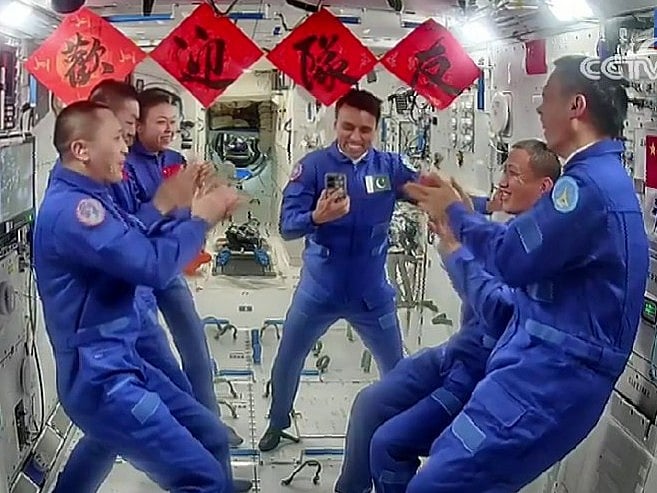
China's Shenzhou-24 spacecraft successfully docked with the Tiangong space station on Wednesday, completing a fast automated rendezvous in about three-and-a-half hours and bringing its three-member crew aboard the orbital outpost.
The spacecraft docked with the forward port of the station's Tianhe core module at 11.56am Beijing time, the China Manned Space Agency (CMSA) said.
Get updated faster and for FREE: Download the Gulf News app now - simply click here.
The Shenzhou-24 crew, Chinese astronauts Tang Hongbo and Wu Yi, and Pakistani astronaut Muhammad Zeeshan Ali, entered the space station and were welcomed by the Shenzhou-23 crew already aboard, according to a post from the Chinese space station on X.
The docking marks a milestone in China's manned space programme, with Ali becoming the first foreign astronaut to fly on a Chinese space mission and the first non-Chinese national to enter Tiangong.
First Pakistani astronaut aboard China's space station
Shenzhou-24 launched earlier on Wednesday from the Jiuquan Satellite Launch Centre in north-western China, carrying two Chinese astronauts and Ali, a Pakistani Air Force pilot and payload specialist.
The spacecraft separated from its rocket and entered its planned orbit before beginning the automated docking sequence with Tiangong.
Ali's flight marks the first joint mission involving Chinese and foreign astronauts in China's manned space programme, following a cooperation agreement between Beijing and Islamabad signed in February 2025.
The mission has drawn celebrations in Pakistan, where officials, scientists, students and members of the public gathered at the headquarters of the country's space agency, SUPARCO, in Islamabad to watch the launch.
Pakistan's national anthem played as the spacecraft lifted off, with spectators cheering and waving Pakistani and Chinese flags.
Planning Minister Ahsan Iqbal, who attended the launch in China, said he hoped the mission would pave the way for greater cooperation between the two countries, including future joint space flights.
Scientific experiments in orbit
The crew is expected to conduct more than 90 scientific experiments and technology tests during the mission, according to China's state news agency Xinhua.
Ali will take part in research involving photosynthetic cyanobacteria, while Pakistani experiments are also expected to explore microalgae, self-healing spacecraft materials and growing quinoa in space.
The mission is part of China's broader space ambitions, which include plans to land astronauts on the Moon by 2030.
With inputs from AP and AFP.
Network Links
GN StoreDownload our app
© Al Nisr Publishing LLC 2026. All rights reserved.