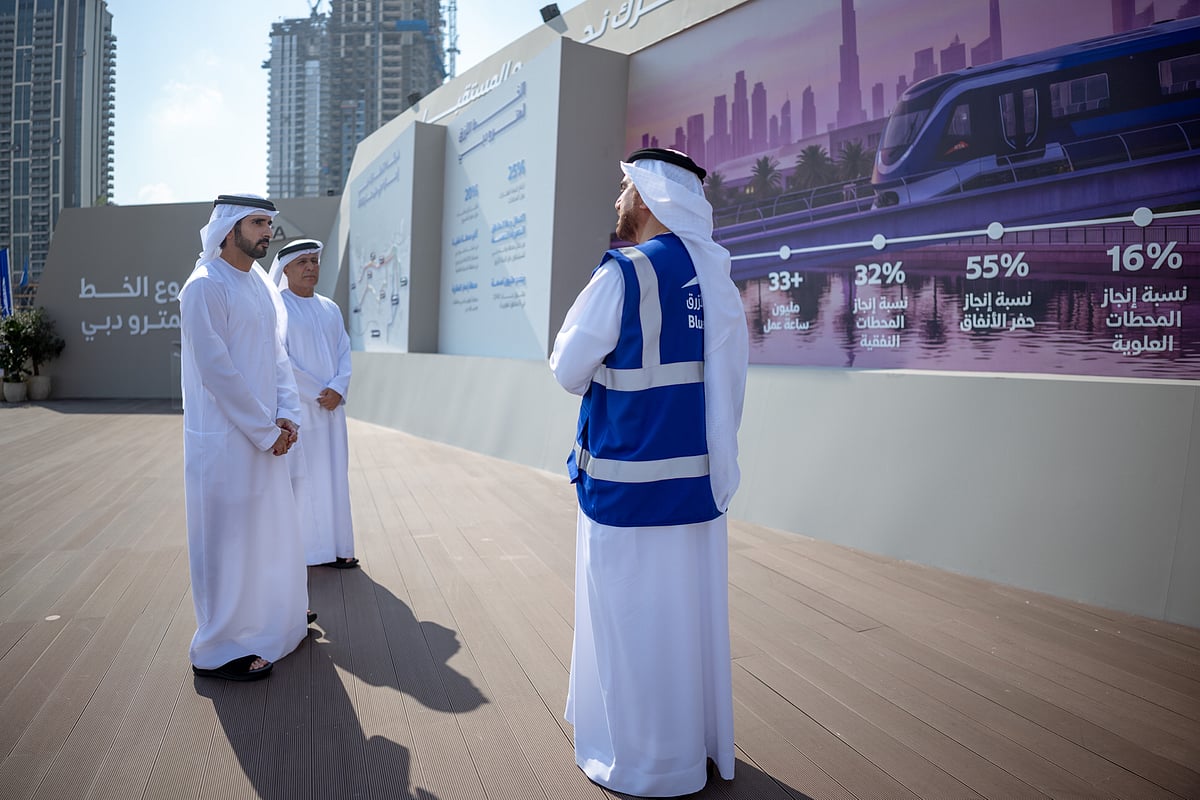
Dubai: Dubai: Sheikh Hamdan bin Mohammed bin Rashid Al Maktoum, Crown Prince of Dubai, Deputy Prime Minister and Minister of Defence, has reviewed progress on the Dubai Metro Blue Line, with construction reaching 29 per cent.
During a visit to the project site in Dubai Festival City, Sheikh Hamdan was briefed on the new train designs, smart technologies and station interiors planned for the line, which is scheduled to open on September 9, 2029.
More than 14,000 workers, engineers and supervisors have contributed over 33 million working hours to the project, according to the Roads and Transport Authority (RTA).
Sheikh Hamdan also reviewed the use of robotics and artificial intelligence (AI) in railway inspection and maintenance, as well as plans for a new research and development centre featuring the Middle East’s first train systems development laboratory.
Get updated faster and for FREE: Download the Gulf News app now - simply click here.
What to expect on the Blue Line trains
Sheikh Hamdan inspected a model of the new Blue Line trains, which will combine modern design, passenger comfort and smart technology.
The trains will have:
Capacity for 675 passengers per journey, with a total maximum capacity of 1,246 passengers.
Three carriage categories: Gold Class, Silver Class, and a dedicated section for women and children.
Digital screens displaying route information, stations, advertisements, time and date.
Wireless charging facilities for smart devices in Gold Class.
Intelligent lighting that adjusts automatically to surrounding conditions.
Advanced cameras and smart systems to detect track obstacles, count passengers and monitor occupancy.
The train interiors have been designed to improve comfort, accessibility and passenger movement, while large windows will offer views of the areas along the route.
Gold Class, wireless charging and smart features
The Gold Class carriage will offer additional comfort and privacy, with contemporary seating, wireless device chargers and intelligent lighting.
Its interior will also feature a distinctive ceiling design inspired by a starry sky.
Silver Class and the dedicated carriage for women and children will focus on practical layouts, passenger capacity and ease of movement. Digital displays will provide dynamic route and station information.
Smart cameras will monitor passenger numbers and occupancy in real time, helping the RTA track crowding and improve operational efficiency.
Five distinctive designs for Blue Line stations
Sheikh Hamdan also reviewed the architectural concepts for the Blue Line stations.
The designs include five themes:
Emaar Properties Station: An iconic design inspired by the concept of a crossing gateway.
Water: One of four concepts drawing inspiration from natural elements.
Air: A design reflecting movement and openness.
Fire: A concept inspired by energy and dynamism.
Earth: A design drawing on natural forms and colours.
The station interiors will combine contemporary architecture with Dubai’s cultural character, using open spaces, natural light, flowing lines and nature-inspired colours.
AI and robotics to improve Metro inspections
The RTA is introducing technology-driven systems to make railway inspection and maintenance safer and more efficient.
Sheikh Hamdan reviewed two initiatives:
1. Automated Rail Infrastructure Inspection System (ARIIS)
Developed by the RTA’s Rail Agency, the mobile system uses Light Detection and Ranging (LiDAR) technology and AI to assess railway infrastructure, identify defects and recommend maintenance.
Its targets include:
Reducing inspection time by 80 per cent.
Cutting the resources required by 50 per cent.
Collecting and analysing 10 times more data.
Improving safety by 50 per cent.
Increasing early fault detection and reliability by 90 per cent.
The system will also reduce the need for inspection teams to enter railway tracks and maintain digital records to support more accurate maintenance planning.
2. Train systems simulator and development laboratory
The RTA is establishing an advanced research and development centre in partnership with CASCO Signal, a specialist in railway signalling, communications and control systems.
The centre will house the Middle East’s first train systems development laboratory. It will allow engineers to test how different train systems work together and simulate operating conditions before they are introduced into service.
The laboratory is expected to:
Reduce testing time by 85 per cent.
Improve the accuracy of the train punctuality indicator to more than 99.7 per cent.
Support technical verification and testing in Dubai.
Help develop and modernise Metro systems.
Blue Line construction: Latest progress
Overall construction has reached 29 per cent, with progress recorded across several parts of the project.
The RTA provided the following figures:
Underground stations: 32 per cent complete.
Tunnel excavation: 55 per cent complete.
Elevated stations: 16 per cent complete.
Bridge works: 17 per cent complete.
Bridge piers: 62 per cent complete.
More than 14,000 workers have contributed over 33 million working hours to construction.
Dubai Creek bridge: A major engineering feature
One of the Blue Line’s key engineering components is a 1.3km bridge across Dubai Creek. It will be the first Dubai Metro crossing over the Creek.
The RTA is using precast concrete segments installed with specialised cranes and platforms operating from completed bridge piers.
This approach is designed to:
Reduce reliance on floating cranes and temporary marine platforms.
Keep marine traffic moving through Dubai Creek during construction.
Improve construction efficiency and workforce safety.
Protect the marine environment.
A dedicated yard near the Creek is being used to produce the concrete segments to specified technical and quality standards before they are transported to the installation sites.
Which areas will the Blue Line connect?
The 30km Blue Line will comprise 14 stations, with 15.5km running underground and 14.5km above ground.
It will include an iconic station at Dubai Creek Harbour and three interchange stations, connecting passengers to the existing Red and Green Lines and linking the Blue Line’s two branches.
The route will serve several residential, educational and business areas, including:
Mirdif
Al Warqa'a
International City
Dubai Silicon Oasis
Dubai Academic City
Dubai Festival City
Dubai Creek Harbour
The line is expected to improve connections between residential communities, business districts, educational institutions and developing areas.
nol payments: What's changing?
Sheikh Hamdan also reviewed the development of Dubai’s nol electronic payment system, which was introduced alongside the Metro in 2009.
The briefing covered the expansion of nol payments to taxis, parking and retail outlets, as well as the nol Plus loyalty programme and digital nol cards.
It also included the move towards account-based ticketing and the next generation of nol–Jaywan cards, launched this month in collaboration with Al Etihad Payments, a subsidiary of the Central Bank of the UAE.
When will the Dubai Metro Blue Line open?
The Blue Line is scheduled to open on September 9, 2029.
The 30km project is a major addition to Dubai’s public transport network and supports the Dubai 2040 Urban Master Plan, which encourages development around public transport stations.
By connecting growing residential communities with business, education and service centres, the line is expected to offer more sustainable travel options and improve access across the emirate.
Sheikh Hamdan said Dubai would continue investing in world-class infrastructure and an advanced mobility network that anticipates future needs and keeps pace with the ambitions of the emirate and its people.
Network Links
GN StoreDownload our app
© Al Nisr Publishing LLC 2026. All rights reserved.