Gender doesn't build successful businesses. Talent and opportunity do
Organisations must remove barriers, empower women and reward measurable performance
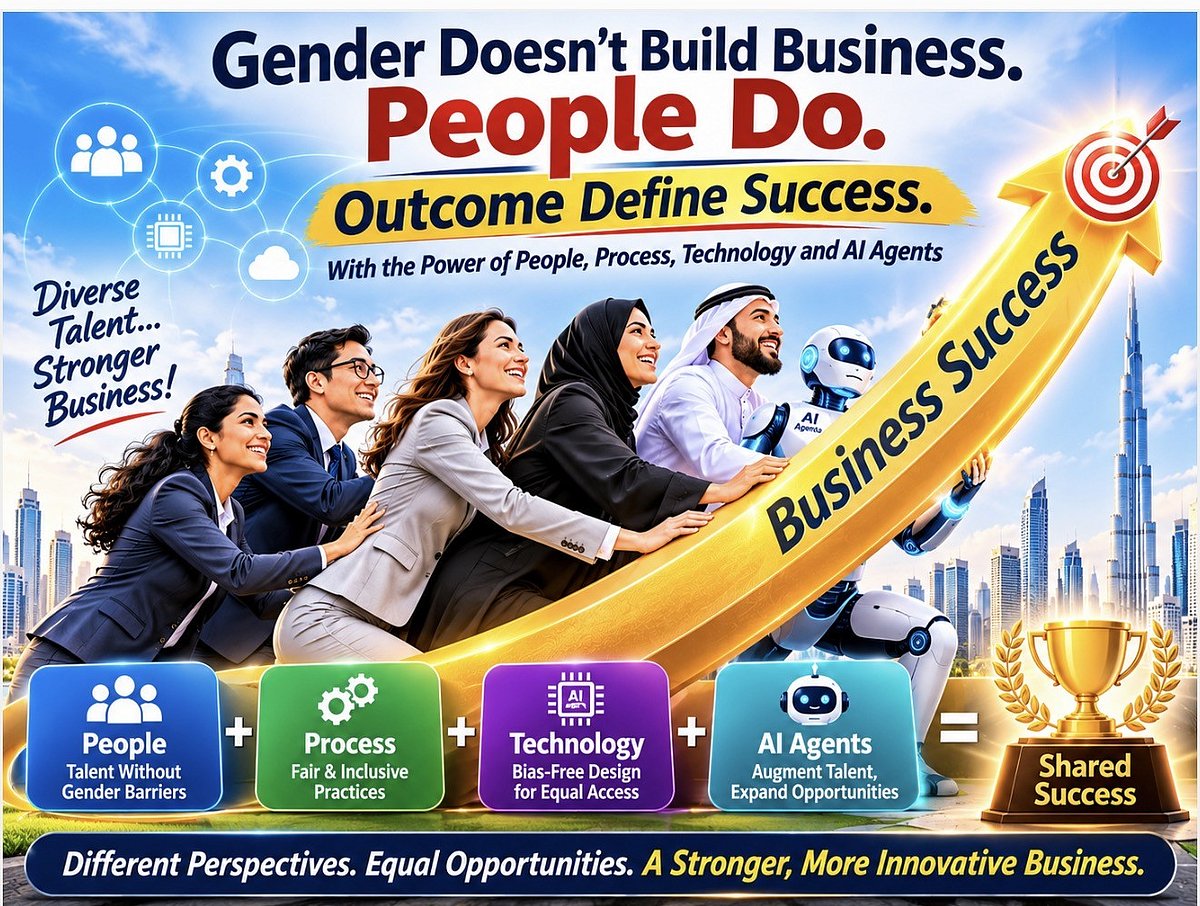
Participating and witnessing countless discussions about gender bias, unequal opportunities, and talented professionals who were overlooked despite their capabilities. While diversity and inclusion remain important conversations, the real challenge is ensuring that opportunity is driven by merit, potential, and contribution rather than assumptions, stereotypes, or unconscious bias. Hearing from many leaders “organizations thrive when they create environments where talent is recognized, nurtured, and empowered to succeed, regardless of gender or background”. The goal is not to favour one group over another, but to build workplaces where everyone has an equal chance to contribute, grow, and create value.
Every successful business ecosystem rests on three fundamental pillars, namely People, Process and Technology and now with 4th pillar AI Agents. Interestingly, neither process nor technology and AI Agents have a gender. A firewall itself does not have gender and will not distinguish between a male and female administrator. An ERP system does not evaluate the gender of the person processing a transaction. A business process does not inherently require a man or a woman to deliver its intended outcome.
Get updated faster and for FREE: Download the Gulf News app now - simply click here.
So why does gender continue to become such a significant variable when organisations discuss leadership, professional opportunities and business success?
Isn't the ultimate purpose of bringing people into an organisation to leverage their capabilities, experience, innovation and ability to create value?
Perhaps it is time to ask a different question, “Are we building organisations around gender representation alone, or around equal opportunity, collective capability and measurable business performance?”
Consider two professionals with identical qualifications, experience and opportunities. Should their gender determine who gets the leadership position, or should their ability to lead, make decisions, manage risks, inspire teams and deliver results determine the outcome?
But here is an equally important question, “Are organisations doing enough to recognise, encourage and embrace women who have the talent and ambition to lead?”
Women should not have to overcome invisible barriers, challenge inherited stereotypes or repeatedly prove their competence simply to receive the same opportunities. Shouldn't organisations actively create environments where women can lead technology transformations, manage business-critical operations, influence boardroom decisions and shape corporate strategy?
Embracing women should not be about offering symbolic representation. Shouldn't it be about recognising their capabilities, removing unnecessary barriers and giving them the authority and opportunity to deliver meaningful outcomes?
What should business leaders measure?
Could organisations move beyond counting how many men and women occupy positions and start examining whether everyone has fair opportunities to deliver meaningful outcomes?
Why shouldn't leadership performance be measured through:
Business outcomes: Revenue growth, profitability, customer satisfaction and operational excellence.
Innovation: New ideas, successful transformations, improved products and competitive advantage.
Risk and resilience: better governance, security, regulatory compliance and business continuity.
People leadership: Team development, employee engagement, collaboration and succession planning.
Accountability: Ownership of decisions, transparency, ethical conduct and delivery against commitments.
Shouldn't these measurements apply equally to every leader, irrespective of gender?
At the same time, shouldn't organisations introduce meaningful sponsorship and mentorship opportunities for women, ensure fair access to strategic assignments, review compensation practices and create leadership pathways that do not penalise career breaks or caregiving responsibilities?
Shouldn't male leaders also become active participants in building inclusive workplaces rather than treating gender equality as exclusively a women's agenda?
Is business success a gender competition?
Does gender equality mean preferring one gender over another? Should organisations replace one form of bias with another? Surely, neither approach creates sustainable business value.
A capable woman should not need preferential treatment to prove her worth. Equally, a capable man should not lose an opportunity because of his gender.
The objective should be a level playing field where everyone competes through capability, contribution and results.
But does creating that level playing field mean treating everyone identically regardless of the barriers they face? Or does genuine fairness sometimes require organisations to address unequal starting conditions?
Perhaps the answer lies in combining equal opportunity with fair recognition and consistent accountability.
The leadership question
Imagine an organisation where women are encouraged to take leadership positions, men are equally encouraged to challenge traditional stereotypes, technology is audited for bias and business processes reward genuine capability.
Wouldn't that be a stronger and more sustainable business ecosystem?
Perhaps the next generation of organisations should move from gender-centric competition to capability-centric collaboration.
Not by ignoring discrimination, but by eliminating it. Not by lowering standards, but by applying fair standards consistently. Not by measuring people through identity, but by giving everyone the opportunity to demonstrate their potential.
Ultimately, businesses do not succeed simply because a man or a woman occupies a leadership chair. They succeed because capable people make informed decisions, lead diverse teams, innovate responsibly and deliver measurable outcomes.
Let's encourage women to lead, embrace their contributions, remove the barriers that restrict their potential and recognise their achievements without qualification.
Because the objective is not to make women fit into an existing definition of business leadership. Shouldn't we also allow their leadership, perspectives and capabilities to redefine what business success can look like?
Gender should never determine someone's professional ceiling. Talent opens the door, opportunity fuels growth, AI Agents amplify capability, and outcomes define success. Great organisations succeed when they focus on potential, performance, and results, not gender.
Network Links
GN StoreDownload our app
© Al Nisr Publishing LLC 2026. All rights reserved.