Impeachment: A trial Filipinos stopped watching
Mineral wealth and political power collide in the backdrop of impeachment drama
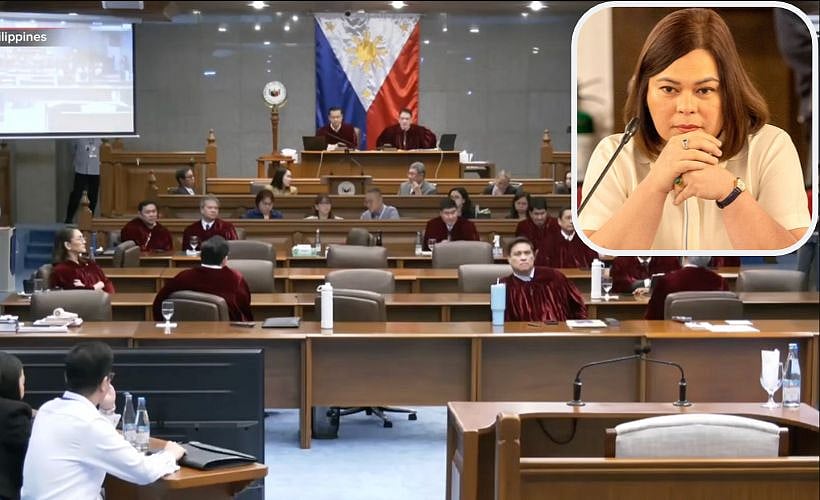
The Senate impeachment trial of Vice President (VP) Sara Duterte was meant to be a national reckoning.
For many Filipinos, it has become background noise.
The warning signs came early.
A Momentum Research survey found only 12.6 percent closely followed the first week, and nearly one in three was barely aware the trial was happening.
About a third called the proceedings confusing, and only 7.2 percent found them "clear".
Get it: Fast, verified news for FREE ... download the Gulf News app — simply click here
Interest has not vanished; but understanding has been short-circuited by objections, jargon and procedural detours.
There are 24 Senator-judges in this trial, per the 1987 Constitution.
Now, Senator Ronald dela Rosa, a Duterte ally, has been absent from the Senate following the unsealing of an International Criminal Court (ICC) arrest warrant in May 2026 and has faced a Senate ethics complaint over his prolonged absence.
Philippine Senator Rodante Marcoleta, also a Duterte ally, is detained at the Quezon City Jail in Payatas, serving a 90-day preventive suspension from the Senate while facing a ₱75-million plunder case
In June 2026, after Senator Jinggoy Estrada faced arrest and a 90-day preventive suspension, the Senate invoked the "Avelino" doctrine to establish a 12-member quorum when some senators were unable to attend.
Estrada, son of former president Joseph Estrada, was previously convicted of bribery. He now faces separate plunder and graft charges tied to flood control kickbacks, with the Sandiganbayan denying his bid in November 2026.
Senate leadership was reorganised in June 2026 with Sherwin Gatchalian as Senate President and Tito Sotto as Senate President Pro Tempore.
In a poll, Pulse Asia found 55 percent of Filipino adults interested, yet 53 percent admitted knowing little about the case.
Meanwhile, 63 percent of voters in one survey called the trial's cost an “unreasonable” use of public funds.
The central question in VP Sara Duterte's impeachment trial has become increasingly specific: Can she satisfactorily explain the origins of hundreds of millions of pesos in alleged wealth, financial transactions and business interests that prosecutors say are inconsistent with her declared assets and income?
The prosecution has assembled a financial case involving bank records, Anti-Money Laundering Council (AMLC) reports, tax documents, corporate records, property titles and forensic accounting.
The defence, meanwhile, disputes the prosecution's interpretation of these records, questions how some evidence was obtained and argues that suspicious-looking transactions do not establish wrongdoing.
As of November 25, 2026, the trial is approaching its final stage, but the Senate has not yet delivered a verdict.
What exactly is Sara Duterte accused of?
An important development changed the scope of the trial.
On October 13, the Senate impeachment court allowed the House prosecution to withdraw three of the four impeachment articles, with prejudice. Only Article II remains.
It concerns three related allegations:
Unexplained wealth: Duterte allegedly accumulated wealth that cannot be adequately reconciled with her legitimate income.
Incorrect or incomplete asset declarations: She allegedly failed to disclose certain assets and financial interests in her Statements of Assets, Liabilities and Net Worth (SALNs).
Prohibited business interests: She allegedly maintained or participated in business interests while holding public office, contrary to constitutional and legal restrictions.
The withdrawn articles concerned alleged misuse of confidential funds, grave threats, and bribery and graft.
Duterte is not being tried for money laundering as a separate impeachment charge.
The prosecution is using financial intelligence and transaction records to support the remaining unexplained-wealth allegations. The Senate clarified this on November 19.
The prosecution's most important witness was Alexander Cabrera, an accountant, lawyer and forensic financial analyst who is chairman emeritus of Isla Lipana & Co., PwC Philippines' member firm.
On October 9, Cabrera presented a financial analysis estimating ₱817,874,867 in alleged unexplained wealth and undeclared assets involving Duterte and her husband, lawyer Manases "Mans" Carpio, covering 2022–2025.
This is the prosecution expert's estimate.
VP Duterte's defence pursued several lines of attack, challenging the forensic accounting methodology.
During cross-examination on October 12, defence lawyer Kristine Ferrer questioned Cabrera about the completeness and reliability of his analysis.
Ferrer also questioned the Anti-Money Laundering Council (AMLC) allegations, arguing that the AMLC reports were being used to suggest wrongdoing connected to allegations that were no longer part of the trial.
After three impeachment articles were withdrawn, defence lawyer Mark Vinluan questioned whether references to possible predicate offences, including graft, malversation and drug trafficking, could still be used.
The key question: Does VP Sara Duterte have 'unexplained wealth'?
On November 19, Senate President Francis Escudero clarified that Duterte was not facing a separate money-laundering charge, i.e. that the trial's focus unexplained wealth.
The AMLC material could still be examined as evidence relevant to the impeachment case. This was an important procedural clarification for both sides.
Then the defence dropped all 16 bank witnesses.
This became one of the most controversial developments. The defence originally intended to present 16 bank representatives to address the financial records.
However, on November 12 and 13, it withdrew all 16.
The defence's original witness strategy was intended to address banking records and requests for documents, but the prosecution argued that the witnesses were needed to rebut the financial evidence.
The prosecution subsequently claimed that the defence had left important bank records effectively unchallenged.
That is a prosecution argument.
The defence may still challenge the interpretation and weight of the records through other evidence and legal arguments.
The central question is about to get an answer: this time from the senators sitting as impeachment court judges. The trial is set to wrap up before the Christmas break, as hoped by many, including Senator-judges.
This is where we are, a process without truth.
Nation-building must rest on truth, not a prolonged legal spectacle. There is no way around it.
As the impeachment trial of VP Sara Duterte unfolds, the country is being asked to look beyond political theatre and confront the facts.
Due process matters.
But a trial that performs procedure while the public cannot follow the substance risks defeating its own purpose.
The Senate-court says it will decide on law and admissible evidence, not public opinion.
That is right in principle. Yet Filipinos are about split on whether Duterte has been treated fairly, 44 percent to 41 percent.
When three of four charges are withdrawn and the remaining one turns on “unexplained wealth”, citizens will ask what the truth is, not whether every objection was properly sustained.
Defenders of the process argue strict procedure is exactly what makes a verdict legitimate.
One survey found 53.5 percent trusted the impeachment court.
But in the realm of social media, to which most Filipinos are exposed algorithm decides. And into this vacuum comes the feed.
Nearly nine in ten Filipino adults use the internet, with Facebook dominant.
One analysis argues platform algorithms reward emotional, identity-driven content. So anger spreads faster than nuance.
A political scientist says public opinion on the impeachment trial is largely shaped by social media.
Truth becomes secondary to loyalty.
Decency in public service becomes a tribal talking point.
Questions raised asking for receipts on the use of taxpayers’ money becomes a battle between Luzon vs Mindanao, Tagalog vs the Visayas, Ilocanos vs Davaoeños.
As social media platforms claim to have invested in fact-checking and moderation, Filipino readers should judge which view the evidence supports.
The stakes extend beyond one office.
The Philippines is currently the world's largest exporter of nickel ore, notes the US International Trade Administration (ITA).
The Philippines holds an estimated 371,260 kg (371.26 metric tons) of commercially recoverable (Class A) gold reserves and 4.14 million metric tons of Class A copper reserves, alongside 66.29 million metric tons of Class A chromite reserves as of 2025, per the Philippine Statistics Authority. Broader estimates place the country's total untapped mineral wealth — across gold, copper, nickel, zinc, silver, and other deposits — at over $1 trillion, with much of its resource base still unexplored. By definition, it belongs to the "sovereign Filipino people".
The estimate includes $170 billion in nickel deposits and about 4.8 million metric tonnes of nickel reserves, with key areas in Zambales, Surigao, Dinagat, and Palawan.
In 2023, more than 87 percent of its nickel ore shipments went to Chinese buyers.
Washington is now courting Manila. And the Philippine ambassador has admitted there is truth to the geopolitical dimension of the US-led Pax Silica initiative.
Leftist activists, anti-war campaigners, and some in the Church, among the noisiest voices in the country, reject Pax Silica, akin to a summary execution.
Without proposing an alternative, or advancing a solution, the dominant local protest culture continues to achieve what it has always done in the past – nothing.
Over-hyped, emotionally-charged sloganeering ("protect the environment/indigenous peoples’ land rights"), produces nothing tangible, no jobs, no innovations, no hope.
Only stagnation.
However you look at it, the status quo — exporting most of the country’s critical minerals in raw form, and mostly to China amid a battery-driven global energy shift — leads to more of the same: A nation and its people living akin to a beggar sitting on a pot of gold.
The government argues that partnerships could let the Philippines process its own nickel and reduce dependence on China.
But the deeper issue is who controls the wealth at home.
Global Witness found that many of the country’s biggest mining firms are tied to "political clans".
A report it cites says "beneficial owners" are hidden behind layers of dummy shareholders. Nearly 80 percent of Congress comes from political families.
The Constitution places minerals under the State, held in trust for the "sovereign people". Yet too little of that wealth has reached them.
The same concentration of power now faces a test in the Senate impeachment trial of VP Sara Duterte.
What's next
The court says it will rule on law and evidence.
The trial resumes Dec. 1 and the Senate adjourns Dec. 19. A reported 20 to 25 days after the defense rests, the verdict follows.
The remedy is plain language.
Explain the evidence.
Publish the findings.
Demand that social media platforms be transparent about what they amplify.
And make mineral ownership public.
These are the most damning challenges the current generation of Filipinos face.
The devil is in the detail.
The Philippines now faces a verdict half the country already rejects, and a country whose resources and attention belong to others.
Network Links
GN StoreDownload our app
© Al Nisr Publishing LLC 2026. All rights reserved.